
![This image features data from Webb’s NIRCam (Near Infrared Camera) and MIRI (Mid Infrared Instrument) to capture the most detailed mid-infrared view yet of the field that hosts the highly evolved star IRS 3, which is located just 0.55 light-years from Sagittarius A*, the Milky Way galaxy's central supermassive black hole. An international team of astronomers have discovered that dust and water can form and survive surprisingly close to this supermassive black hole. The observations reveal that the evolved star IRS 3 continues to enrich its surroundings with newly formed material despite the intense radiation environment around Sagittarius A*. The data in this image were taken with Webb programmes #1939 (J. Lu), #3571 (F. Yusef-Zadeh), #2491 (N. B. Sabha), and #2075 (C. Chan). [Image description: A dense star field fills the entire image, with countless stars scattered across a backdrop of glowing clouds in shades of red, orange, pink, white, and blue. At the centre, a brilliant concentration of stars creates a bright, almost white core surrounded by intricate filaments and wisps of illuminated gas and dust that radiate outward. Dark, irregular patches of opaque dust interrupt the glowing clouds, particularly toward the left side of the image, where they appear as silhouetted shapes against the brighter background. The surrounding stellar population varies in brightness and colour, with cool blue stars and warmer orange and red stars distributed throughout the scene.]](https://www.popsci.com/wp-content/uploads/2026/08/IRS3-Star.jpg?quality=85&w=2000)
Inside almost every known galaxy lurks a supermassive black hole, and our home Milky Way galaxy is no exception. Located about 26,000 light-years from Earth, Sagittarius A* anchors millions of stars and their planets with its incomprehensibly gargantuan gravitational pull. But after reviewing recent observations made by NASA’s James Webb Space Telescope (JWST), astronomers discovered that some material can exist closer to a galactic black hole than previously believed. Despite existing just 0.55 light-years from Sagittarius A*, the ancient star known as IRS 3 is shooting out immense stellar winds while surrounded by oxygen-rich dust and even water.
“Galactic centers are among the most extreme environments, so understanding whether stars can continue enriching their surroundings there is an important question,” said Florian Peißker, an astronomer at Germany’s University of Cologne and the co-author of a paper on the discovery published today in the journal Astronomy and Astrophysics.
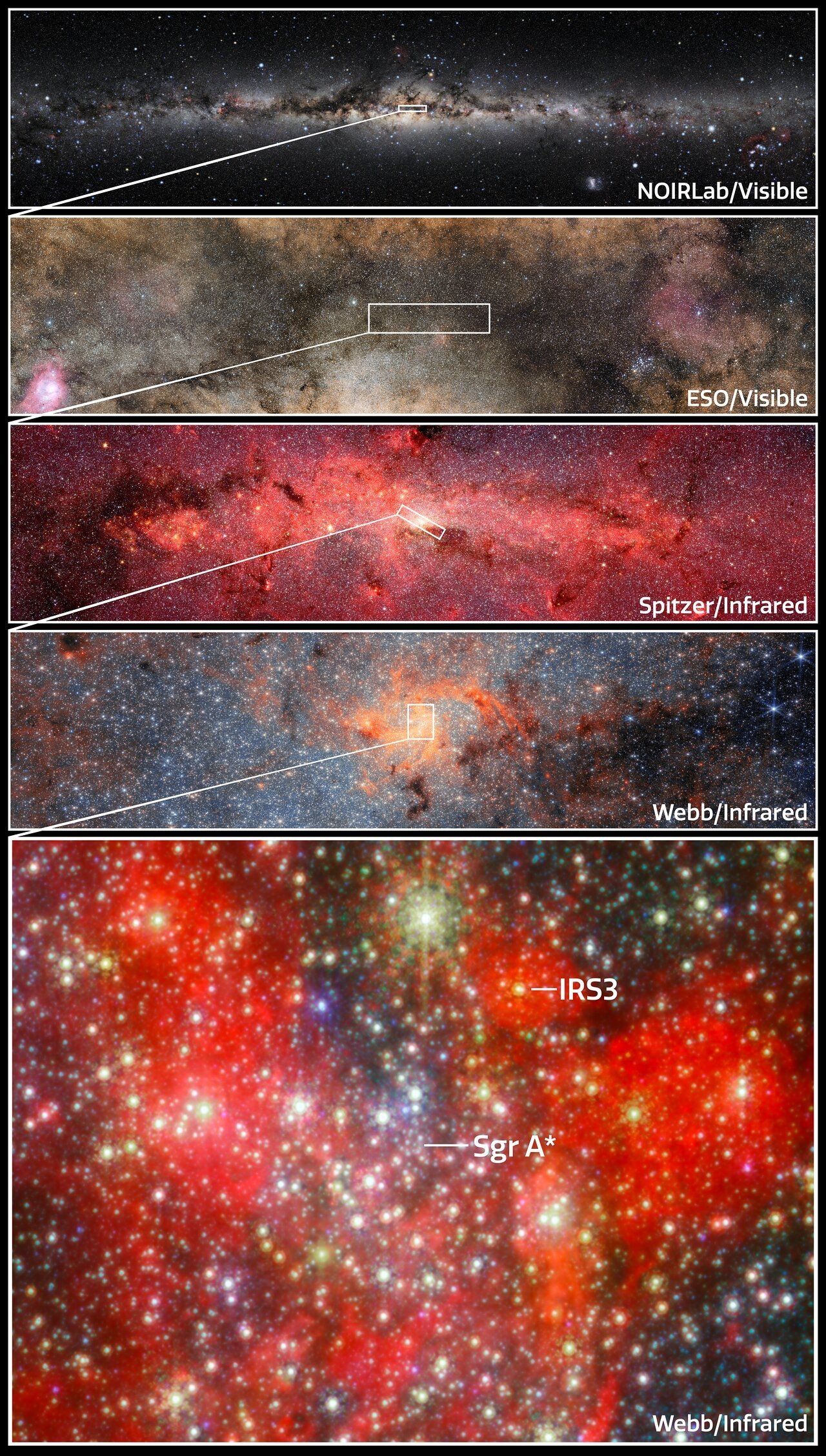
Stellar deaths are vital parts of the galactic life cycle. As a star begins to die, it sheds waves of gas into space that later form the foundations of cosmic dust. In turn, this space dust becomes the building blocks for planets and other celestial objects. The star at the center of our galaxy’s black hole, IRS 3, is a perfect example of these interactions. After 72 million years of existence, IRS 3 has entered its asymptotic giant branch phase, making it bright, cool, and about six times the sun’s mass. Astronomers have long known IRS 3 should hypothetically emit gas along its stellar winds, but they were unsure if that was even possible given its proximity to Sagittarius A*.
Previous data indicated IRS 3’s large dust envelope implied that the star was rich in carbon, but JWST has supplied evidence to the contrary. Using its Mid-Infrared Instrument (MIRI), researchers detected two strong signatures that align with silicate dust made from oxygen and silicon. This means that IRS 3 possesses a lot of oxygen as it nears the end of its life.
The team used advanced simulation models to test how radiated light might move through different types of surrounding cosmic dust envelopes. The astronomers then used those models to build a theoretical structure of IRS 3’s actual envelope. They now believe the elderly star is surrounded by a layered shell of cosmic dust spanning about 0.15 light-years in every direction. Temperatures near the star hover around 1,700 degrees Fahrenheit, while the outer layers average about -280 Fahrenheit. For the first time, researchers also noted clear signs of water within the envelope of a star like IRS 3.
European Space Agency (ESA) astronomer Macarena Garcia Marin described the discovery as “especially exciting,” because it indicates foundational molecular material like water can still exist in intensely hostile, irradiated environments.
“This tells us that even close to a supermassive black hole, stars can continue contributing material back into their surroundings,” she added.
