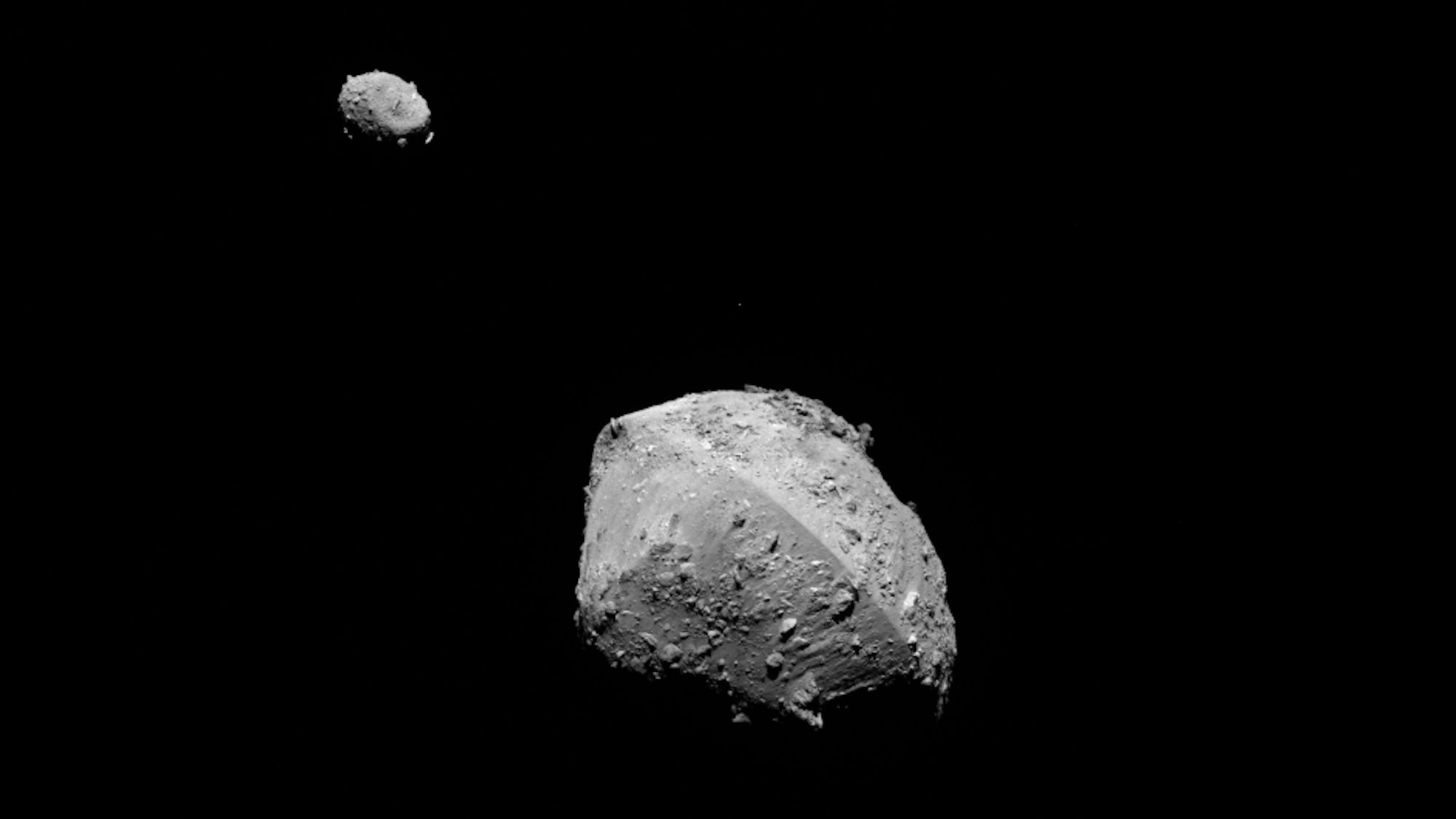
After over four years of years of anticipation, the European Space Agency has obtained images detailing the aftermath of NASA’s head-on collision with the asteroid Dimorphos. The photos and scans from ESA’s Hera spacecraft highlight the results of the Double Asteroid Redirection Test’s (DART) intentional run-in with Didymos’ 500-foot-wide moonlet Dimorphos in 2022, revealing a stadium-sized crater, cloud of boulders, and a new, erratic orbital path.
“Scientists debated whether Dimorphos had sustained an impact crater, changed its shape, or stayed the same,” Hera principal investigator Patrick Michel said in a statement. “Much to our surprise the answer turns out to be all three at once!”
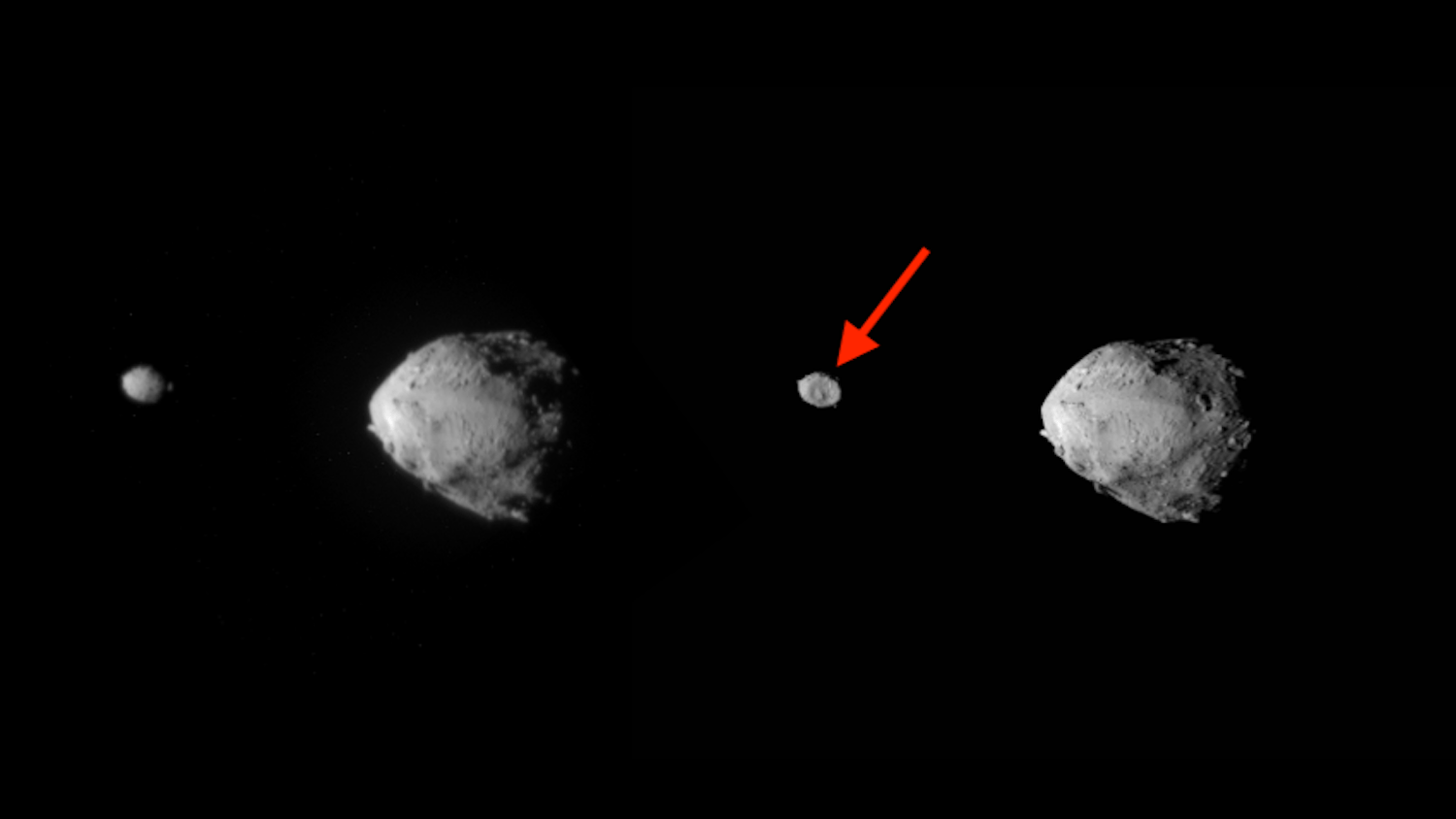
Michel explained that while DART flattened one side of Dimorphos into a massive crater, the rest of the space rock isn’t much different. Fields of boulders largely remain where they could be seen in DART’s photos from 2022, although the event did drastically change the binary system’s surroundings.
“Another big surprise is that Hera is showing that the asteroids are surrounded by hundreds of orbiting boulders, just a few meters in size,” added mission scientist Michael Kueppers.

Animation: Dimorphos orbiting Didymos seen from northern side
Hera employed three instruments during its first observations—a thermal infrared imager to measure surface temperature, a 25-color multispectral imager, and a monochrome camera.
The car-sized probe’s work is only just getting started, too. In December, Hera will ultimately travel to barely eight miles from the asteroids, while obtaining increasingly higher-resolution photos. The spacecraft will then deploy a pair of CubeSats to get even closer to the binary system in January 2027. If all goes as planned, one of those devices will even attempt to land on the surface of Dimorphos. The combined measurements from this phase will help researchers understand the impact’s efficiency and improve future deflection strategies.
Hera’s first images were debuted at the dinosaur hall of the Berlin Natural History Museum—an intentional choice on the team’s part.
“Sixty-six million years ago, an asteroid impact changed the course of life on Earth,” said Hera mission manager Ian Carnelli. “Today, for the first time in history, humanity is validating how to prevent such an event from happening again.”