
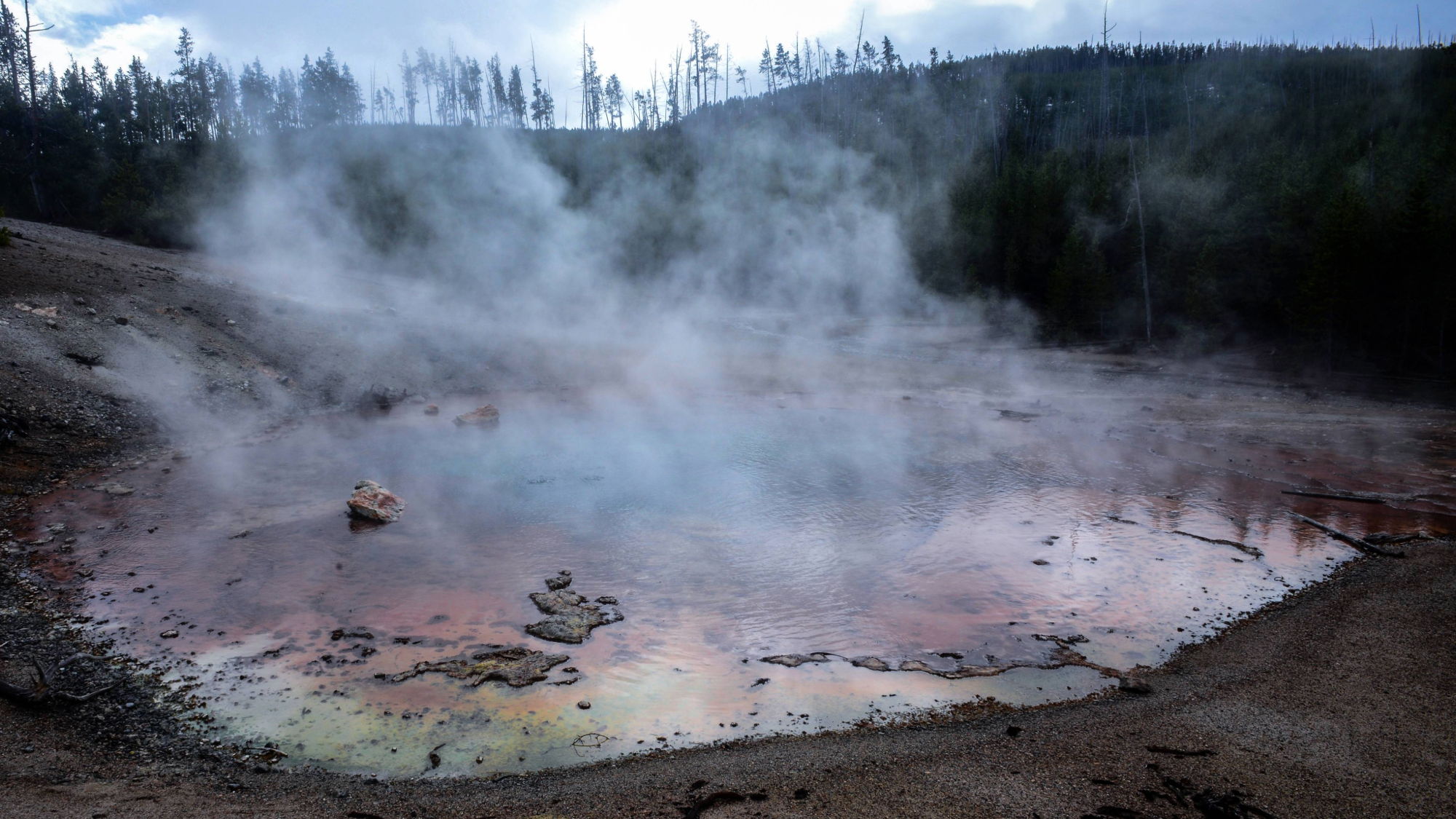
The world’s largest acidic geyser is erupting for the first time in six years. Yellowstone National Park’s Echinus Geyser is part of the very active Norris Geyser Basin in Wyoming. In early February, the geyser began spewing out acid and water up to 30 feet into the air. The new eruptions highlight the power of the hottest and most dynamic region of Yellowstone National Park.
Acid geysers like Echinus are considered rare since acidic water is usually powerful enough to break down the rock that makes up a geyser’s plumbing system. However, Echinus’ acidic water composition comes from the mixing between acidic gases and neutral waters. This means that there is not enough acid in the water to eat away at the rock.
According to the United States Geological Survey (USGS), this unusual water chemistry creates some interesting formations, compositions, and color. The red color that surrounds the geyser pool and the silica-covered spiny rocks come from iron, aluminum, and arsenic.
The Echinus Geyser pool itself is about 66 feet across. Since the acid itself is not concentrated, it is not particularly dangerous and the USGS says it has a similar acidity to orange juice or vinegar. However, the water temperatures can reach upwards of 200 degrees Fahrenheit, so visitors should be cautious. The Norris Geyser Basin is also home to the tallest active geyser on Earth—Steamboat Geyser.
Related National Parks Stories
Geologists believe that the Echinus Geyser was mostly dormant except for occasional eruptions until 1948. During the 1970s, it erupted in regular 40 to 80 minute intervals, before becoming more extreme in the 1980s and 1990s. These more intense eruptions could sometimes last over 90 minutes. By the early 2000s, the eruptions started to wind down and the activity became much less common as temperatures cooled.
The geyser really came alive in fall 2017. From October 18 to November 10, 2017, Echinus consistently erupted roughly about every two to three hours. The activity then stopped with only one eruption in January 2018 and 2019 and then two in December 2020.
This year marks Echinus’ first eruption since 2020. In early February, the geyser’s surface became agitated and started releasing more water down the runoff channel. Beginning on February 16, the eruptions began repeating every two to five hours, lasting about two to three minutes, and water levels reached 20-to 30-feet high. The USGS says that this pattern resembles what happened in 2017.
To follow the Echinus Geyser’s activity from anywhere, users can monitor the temperature graphs on the Yellowstone Volcano Observatory’s website. Spies that reach about 158 degrees Fahrenheit are eruptions, while those at 104 °F are the surges. The eruptions are not expected to last into the busy summer tourist season at Yellowstone, so watch while you can.
