
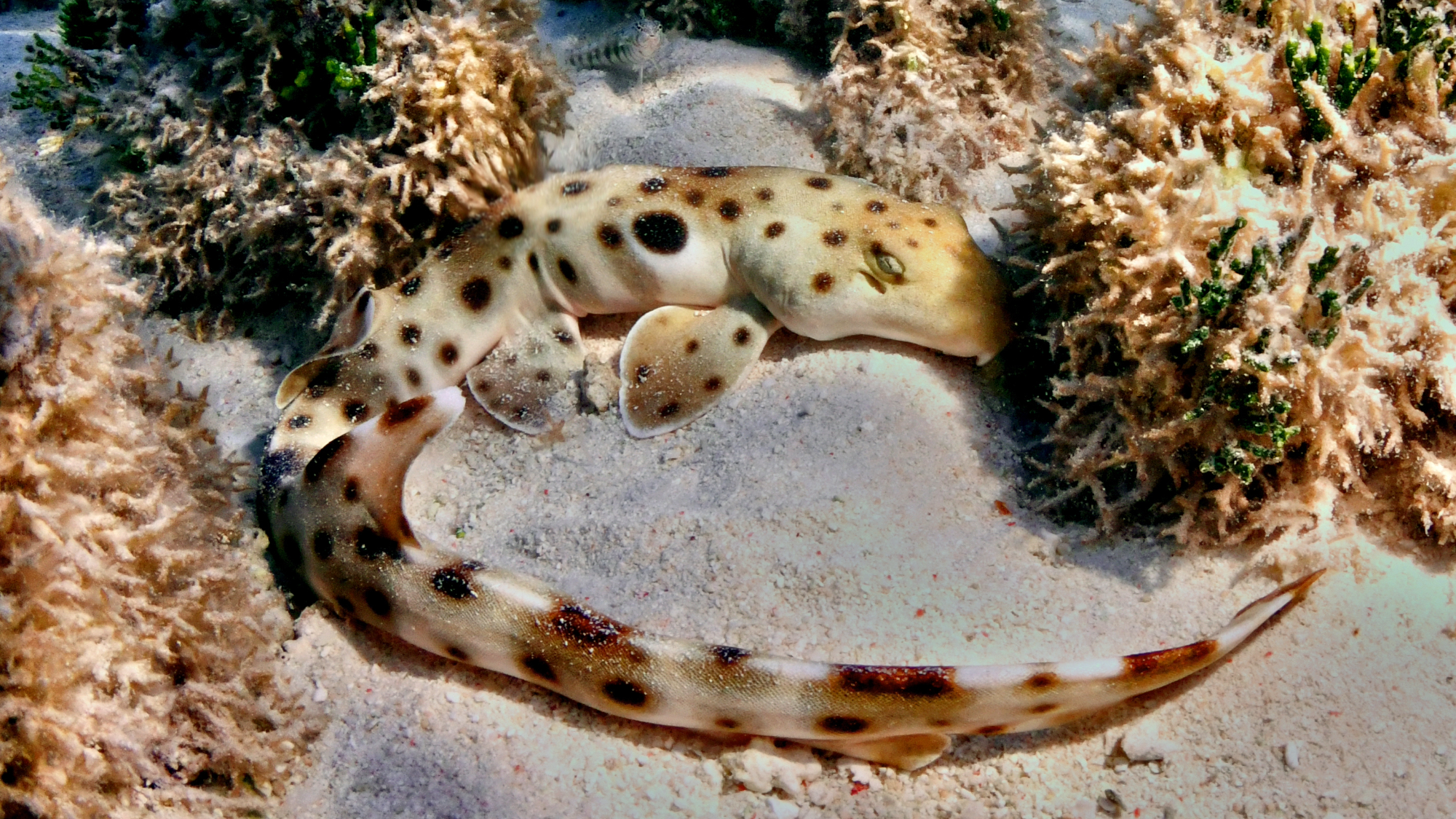
Being pregnant and giving birth is hard work for any species—but epaulette sharks (Hemiscyllium ocellatum) might disagree.
These fish and a number of other species are known as “walking sharks” for their ability to traverse both the seafloor and land with their fins. But as of now, that’s no longer the coolest thing about this rather adorable predator. Epaulette sharks’ energy use didn’t change during their reproduction cycle, as described in a study recently published in the journal Biology Open.
“Reproduction is the ultimate investment … you are literally building new life from scratch,” Jodie Rummer, a marine biologist at James Cook University and co-author of the recent study, said in a university statement. “We expected that when sharks make this complex egg, their energy use would shoot up. But there was no uptick in energy use, it was completely flat,” she adds. They “appear to have adapted their physiology to be able to optimise their energy use.”
Researchers broadly believe that reproduction is a major energy investment for a majority of species. The new study, however, represents the first time scientists have recorded sharks’ reproductive cycle’s direct energetic expenditure (or metabolic cost). The sharks in the new study were living in captivity, and the researchers analyzed the rates of their oxygen consumption as a way to track their metabolic rate.

Baby shark in egg
Furthermore, the team monitored shifts in blood and hormones while the mother sharks laid eggs, explained lead-author Carolyn Wheeler, also from James Cook University.. The sharks proved to be, once again, unphased.
“Everything was remarkably stable, so this research challenges our fundamental assumptions about chondrichthyan fishes (sharks, rays, skates and chimaeras),” Wheeler said.
During times of environmental stress, many species will choose between reproduction and survival. However, the epaulette shark may still continue to produce eggs, even under major stressors. According to the team, this is encouraging since healthy sharks equal healthy reefs and ecosystems.
“This work challenges the narrative that when things go wrong—such as warming oceans—that reproduction will be the first thing to go,” Rummer explained.

Adult epaulette shark swimming
We need to understand the extent of this small shark’s apparent significant resilience in the face of the aforementioned issue, she added.
“Sharks have been around since before the dinosaurs and have already shown incredible resilience to the earth’s changing climate,” Madoc Sheehan, media liaison officer and a senior lecturer at James Cook University, who is not one of the study’s authors , tells Popular Science, “these new observations reinforce [our understanding of] their capacity to endure change.”
Moving forward, the team plans to investigate how much it takes wild epaulette sharks to produce eggs.
