
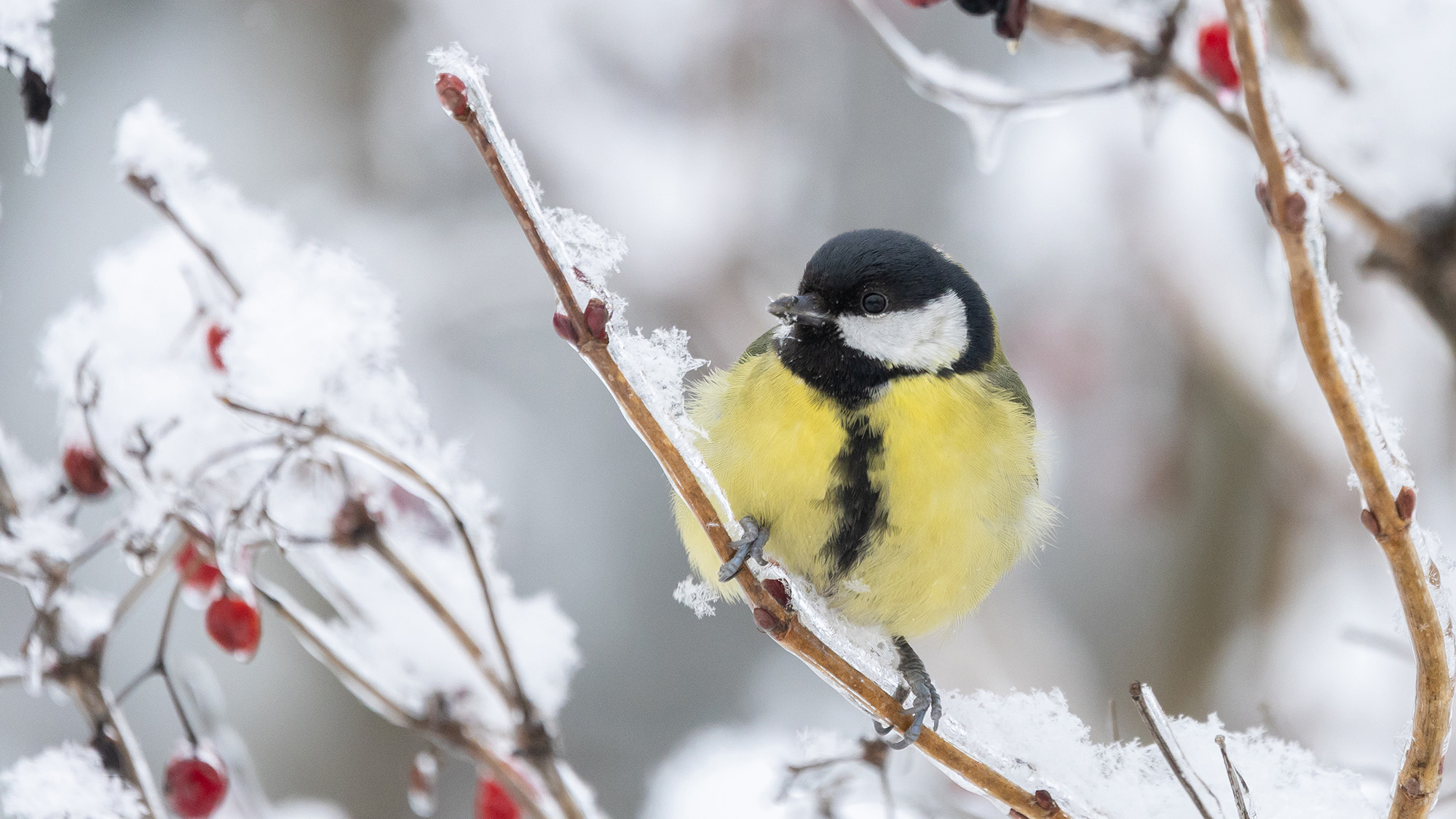
You’re at the park wearing a heavy winter coat, a beanie, gloves, a scarf, and warm boots—and you’re still numb and shivering from the cold. Then you notice a robin hopping from branch to branch. Nearby, ducks are calmly swimming in the pond and waddling around on the ice.
How do birds survive such freezing conditions?
A natural thermal base layer
Birds have a big advantage over us: feathers.
In winter, birds actually grow more feathers. “Their feather density increases anywhere between 35-70% in the colder months,” says Ava Michelangelo, a teacher-naturalist at the Connecticut Audubon Society.
“So just like how our attire goes from T-shirts and shorts in the summer to jackets and long pants in the winter, these birds go through a similar change.”
Birds have different kinds of feathers, and one type is especially important in cold weather: down feathers. These feathers are very fluffy and grow close to the skin, essentially acting like a thermal base layer. “Of the several types of feathers birds possess, down feathers are excellent at trapping body heat,” says Anna Pidgeon, professor of forest and wildlife ecology at the University of Wisconsin-Madison.
(Unfortunately, this has also led to down feathers being used to stuff jackets, duvets and other objects, although ethical brands now use synthetic insulation that mimics down.)
Why birds puff up in winter
You might also notice birds looking extra round and fluffed up on cold days. “What they are doing is trapping air between their feathers, which is then getting warmed by their body,” explains Michelangelo.
Birds also reduce heat loss by covering their feather-less body parts, says Pidgeon. For example, they might tuck their beaks into their back feathers or under their wings, and squat down to cover their bare legs and feet.
They might also stand on one leg, with the other leg tucked among their breast feathers. This reduces by half the surface area of bare skin exposed to the cold.
Shelter from the cold
When it gets extremely cold and windy, birds seek shelter just like we humans do.
Pidgeon explains that some birds, like horned larks and snow buntings, hide behind small bumps in the ground to block the wind. Others, like rock ptarmigan and grouse, burrow in the snow, using the snow as insulation.
“Some birds are lucky enough to have a suitable cavity within their winter area, for example within a dead tree or one with a decaying branch,” says Pidgeon. Woodpeckers often sleep alone in these shelters, but smaller birds—like chickadees, bluebirds, and titmice—sometimes huddle together inside cavities, “taking advantage of each others’ body heat.”
Built for the cold
While many birds avoid winter altogether by migrating, the ones that stay behind are often specially equipped for cold weather.
“The birds that we see year round in Connecticut, like the beloved Black-capped chickadee, are species that do really well here in winter,” says Michelangelo.
“They are constantly shivering to generate heat while searching for high fat foods, like seeds.” Shivering works the same way in birds as it does in people: moving muscles burns energy, and that energy becomes heat.
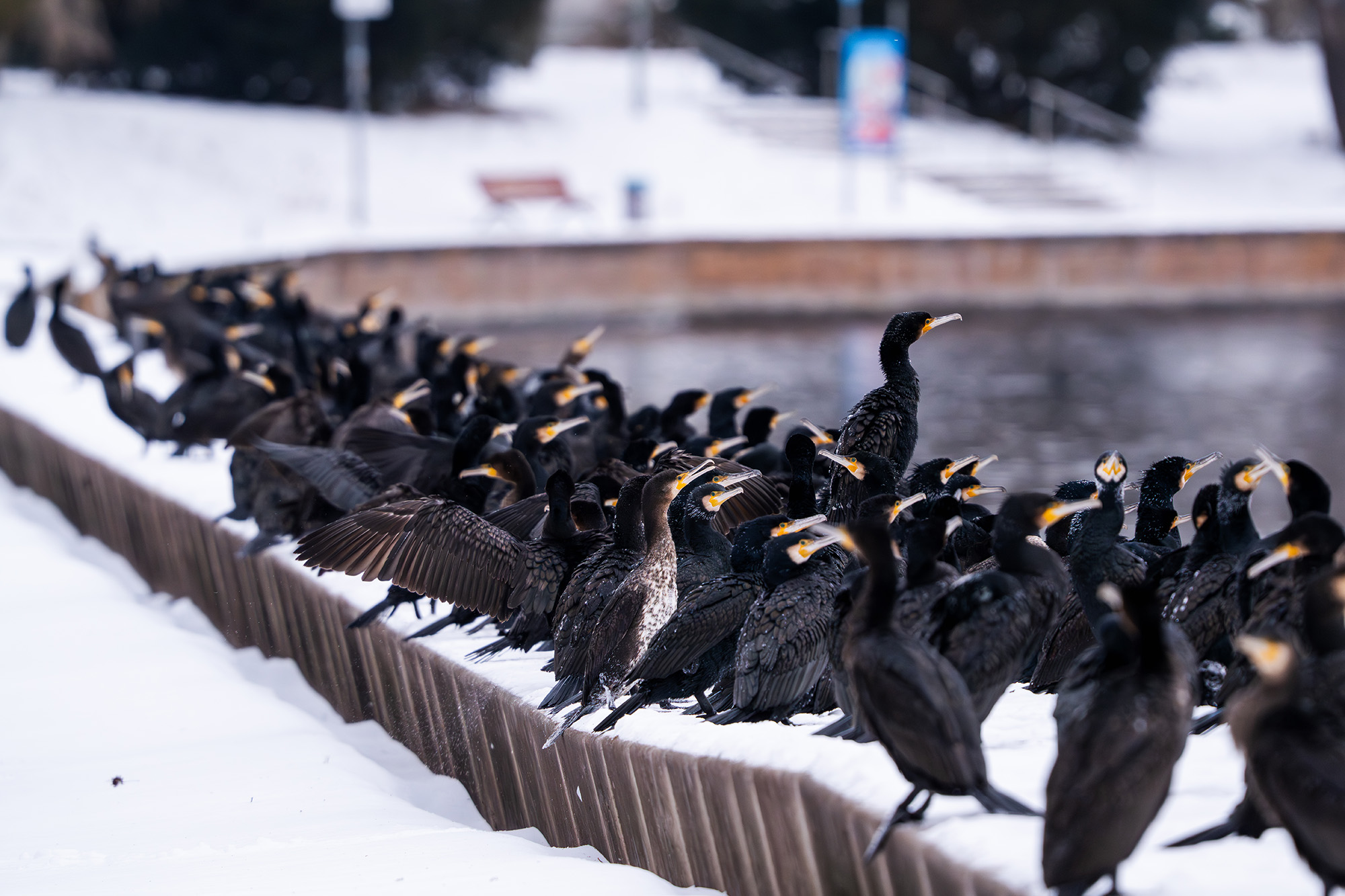
Ducks, gulls, and other waterbirds have an amazing trick, too. “On the days that the salt marsh is frozen over, you’ll still find these birds resting on the frozen ice,” says Michelangelo.
Waterbirds also have very few pain receptors in their feet, so they don’t experience the cold the way a human would if standing barefoot on ice. On top of that, they reduce heat loss using a process called countercurrent heat exchange. Heat from warm blood traveling down to the feet is transferred to cooler blood flowing back toward the body before it reaches the core. This way, the bird’s core temperature doesn’t plummet, yet the feet still receive enough oxygen to function.
Research has also shown that gulls can restrict the amount of blood going to their feet, Pidgeon says. This reduces the amount of body heat lost to the icy surface or water.
Related 'Ask Us Anything' Stories
Fuel for warmth
Just like people stock up on groceries before a snowstorm, many birds store food ahead of time. During warmer months, they hide seeds and insects in bark crevices, and under the edges of lichens so they can eat later when food is harder to find, says Pidgeon.
If food is especially scarce, some birds have another strategy: daily torpor. This is a short period when they lower their body temperature, heart rate, and breathing to save energy. It’s not the same as hibernation and usually lasts less than 24 hours. In hummingbirds, torpor can reduce energy use by up to 95%!
Chickadees also have a food-related superpower that helps them survive the cold months. “Their hippocampus, the part of their brain that stores memories, is larger in the winter,” says Michelangelo. “This helps them remember where they have cached their food.”
A single chickadee can store up to one thousand seeds a day, or 80,000 in a season. (A single squirrel, on the other hand, only buries up to 3,000 nuts in a season.)
So, yes, winter may be harsh, but birds are ready for it.
In Ask Us Anything, Popular Science answers your most outlandish, mind-burning questions, from the everyday things you’ve always wondered to the bizarre things you never thought to ask. Have something you’ve always wanted to know? Ask us.
